MAYA
MOUNTAINS
That's one we'd missed on previous trips, so in 2005 we headed
farther into the Maya Mountains to find this bird and others.
In 2005 some found our target; others missed it so we'll try again. But
none of us were disappointed. Among many other serendipitous sightings, we
watched an Ornate Hawk-Eagle hunting, first a rodent on the ground and then a
squirrel in a tree. What a photographic opportunity!
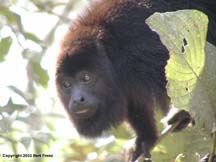
In 2006, after following its call for a half-hour we finally got great views of a Tody Motmot on our visit to Caracol, Belize's largest known Maya site. Not excavated until 1950, over 35,000 buildings have been identified, including a 139-foot-high pyramid. While an estimated 180,000 people lived there once, now it is home mostly to exotic birds and howler monkeys. On our 2006 trip we found all four native trogons, including prolonged looks at a calling Collared Trogon. While we are in the vicinity next trip, we might even find one of the Harpy Eagles released in the Chiquibul Forest. We'll also stop at Rio Frio Cave, entered through a 65-foot archway.
 But
that's not all we'll see on this side-trip. Traveling from San Ignacio, we'll leave
our RV's at the campsite to
visit and stay overnight at Mountain Pine Ridge, a submontane pine forest of the Maya Mountains.
Species that we could pick up there, and miss elsewhere, are Orange-breasted
Falcon, Black-headed Siskin, Plain Wren and Rusty Sparrow. The past three
years we found a
pair of the falcons nesting beside a dramatic waterfall plunging over the edge
of the mountains and, at 1500 ft., believed to be the tallest waterfall in
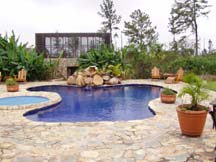
Central America. We'll stay at a lovely resort overlooking the valley
below and find Azure-crowned Hummingbirds, Yellow-tailed Orioles and Green Jays
at the feeders. King Vultures and all three Belize species of Hawk-Eagles
fly over the extensive 7200 acres of preserve surrounding the resort. In 2005
we discovered a very rare pair of Solitary Eagles
and watched them mating. The occasion was so unusual that the report was
included in the winter issue of North American Birds, including the
photo. That night we watched a Stygian
Owl by spotlight. In 2006 we studied a Lovely Cotinga for an hour and
still didn't tire of this beauty. We still have more to discover: Crested Guans and Great Curassows lurk in the deep
forests. We'll have the benefit of a local guide to lead us on special trails
to good birding spots.
But
that's not all we'll see on this side-trip. Traveling from San Ignacio, we'll leave
our RV's at the campsite to
visit and stay overnight at Mountain Pine Ridge, a submontane pine forest of the Maya Mountains.
Species that we could pick up there, and miss elsewhere, are Orange-breasted
Falcon, Black-headed Siskin, Plain Wren and Rusty Sparrow. The past three
years we found a
pair of the falcons nesting beside a dramatic waterfall plunging over the edge
of the mountains and, at 1500 ft., believed to be the tallest waterfall in
Central America. We'll stay at a lovely resort overlooking the valley
below and find Azure-crowned Hummingbirds, Yellow-tailed Orioles and Green Jays
at the feeders. King Vultures and all three Belize species of Hawk-Eagles
fly over the extensive 7200 acres of preserve surrounding the resort. In 2005
we discovered a very rare pair of Solitary Eagles
and watched them mating. The occasion was so unusual that the report was
included in the winter issue of North American Birds, including the
photo. That night we watched a Stygian
Owl by spotlight. In 2006 we studied a Lovely Cotinga for an hour and
still didn't tire of this beauty. We still have more to discover: Crested Guans and Great Curassows lurk in the deep
forests. We'll have the benefit of a local guide to lead us on special trails
to good birding spots.
In 2005, this side-trip was 2-days / 1-night. Unanimously, the group recommended we make our subsequent trips 3-days / 2-nights. In fact, a few would have loved to stay a week. So here is what we have in store for our next trip.
 Package
Features
Package
FeaturesPrice includes: