MANITOBA - CHURCHILL BIRDING EXPEDITION
Tour Description
24 Day Tour
May
28 to June 20, 2011
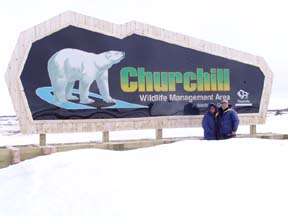 Did you ever get the urge
to travel to the end of the rainbow? You'll get that feeling on this trip to the Hudson
Bay. We'll start on the U.S.-Canada border in North Dakota, birding our way through
southwestern Manitoba during prime migration time, reaching the end of the highway in
Thompson and then taking the train through the northern Manitoba tundra until we reach the
end of the railroad at the iced-over Hudson Bay. Our arrival is timed to catch the ice
breakup of the Churchill River as it dumps into the bay, a stopping point for northward
bound migrants. Wintering species should still be in the Churchill area, so we hope to see
Snowy Owl, Snow Bunting and Rock Ptarmigan before they head to breeding grounds even
farther north. Migrants, such as Lapland Longspurs and Canada, Snow and Ross's geese,
Did you ever get the urge
to travel to the end of the rainbow? You'll get that feeling on this trip to the Hudson
Bay. We'll start on the U.S.-Canada border in North Dakota, birding our way through
southwestern Manitoba during prime migration time, reaching the end of the highway in
Thompson and then taking the train through the northern Manitoba tundra until we reach the
end of the railroad at the iced-over Hudson Bay. Our arrival is timed to catch the ice
breakup of the Churchill River as it dumps into the bay, a stopping point for northward
bound migrants. Wintering species should still be in the Churchill area, so we hope to see
Snowy Owl, Snow Bunting and Rock Ptarmigan before they head to breeding grounds even
farther north. Migrants, such as Lapland Longspurs and Canada, Snow and Ross's geese,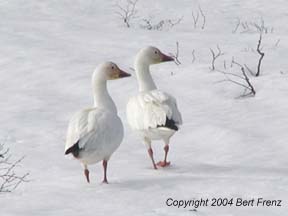 can be
present by the thousands before they head farther north, although some will stay to nest.
At the same time, the local breeders should be arriving and we'll be looking for Smith's
Longspurs, Ross's Gull, Little Gull, Arctic Tern and a long list of others.
can be
present by the thousands before they head farther north, although some will stay to nest.
At the same time, the local breeders should be arriving and we'll be looking for Smith's
Longspurs, Ross's Gull, Little Gull, Arctic Tern and a long list of others.
While Churchill will undoubtedly be the highlight of this trip, let's run through the
itinerary to see what other adventures you're in store for. After our rendezvous in Rugby,
North Dakota, we'll head to the prairie lands of the Manitoba-Saskatchewan border,
spending the night at a nearby campground. The next day we'll explore this area for
prairie specialties such as Ferruginous Hawk, Sharp-tailed Grouse,
Sprague's Pipit, Baird's and Grasshopper sparrows and Chestnut-collared Longspurs.
Our next few nights will be in Brandon, at the center of many good birding sites. We'll
visit a marsh famous for its Yellow Rails. Even though an estimated 500 pairs nest in this
marsh, they can be notoriously difficult to see, but we should at least be able to hear
them mixed in the loud chorus of Sora rails and, if we're lucky as we were one year,
we'll see one too. A large pond near Brandon was especially productive one year and we
counted 34 species in less than an hour, including Western Grebe, Red-necked Phalarope and
Black Tern. On another day we'll hike a pleasant trail through a wooded area where we
could see Cooper's Hawk, Ruffed Grouse, Pileated Woodpecker, Winter Wren, Black-billed
Cuckoo and Ovenbird. Nearby we've found California Gulls and large flocks of Yellow and
Yellow-rumped warblers displaying brilliant spring plumages. Throughout our days here,
we'll be watching for Gray Partridge in the fields and roadsides as we move between
birding sites. On a trip through Manitoba's pothole country, 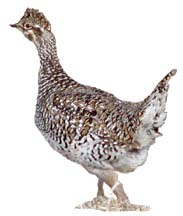 the number
of ducks that love this habitat will impress you. This will be the start of a long list of
waterfowl we'll find throughout our itinerary, which one year culminated with 29 species
of geese, swans and ducks, totaling tens of thousands of birds. Migrants could be peaking
during our Brandon stay and we could see dozens of Swainson's Thrushes in a day.
the number
of ducks that love this habitat will impress you. This will be the start of a long list of
waterfowl we'll find throughout our itinerary, which one year culminated with 29 species
of geese, swans and ducks, totaling tens of thousands of birds. Migrants could be peaking
during our Brandon stay and we could see dozens of Swainson's Thrushes in a day.
Our next stop, at Riding Mountain National Park, could be another hotspot for migrants,
as well as an opportunity to see local specialties such as Black-backed and American
Three-toed woodpeckers and Great Gray Owl. Although a bit early, a real prize would be
Connecticut Warbler and we are likely to have a better chance for this rarity late in the
trip. The National Park provides numerous hiking trails and roads through pristine forests
and prairie, and we'll probably see Plain's Bison, Moose, Elk, Snowshoe Hare and smaller
mammals. A long boardwalk through a marsh gives us closer views of its denizens and
another one passes between marsh and woodland crisscrossing a stream where migrant
warblers gather to eat. Yellow-green spring leaves will be popping out on the birch and
aspen, yet snow may still lie in crevices. We could well experience three seasons
compressed into three weeks during our trip.
Farther north, the land flattens into farmlands, eventually usurped by spruce wetlands
and numerous lakes at latitudes with too short a growing season to support agriculture.
The excellent highways are mostly empty of traffic and wildlife often approaches
roadsides. Here we'll find Sandhill Cranes, Osprey and perhaps a Great Gray Owl as we did
several years - one that waited patiently for us to align a spotting scope on its rounded
face. We also are likely to encounter Black Bears along the roadsides, perhaps attending
cubs. At one of our campsites Cape May Warblers squeak thin songs high in the black spruce
where they nest and pairs of Red-necked Grebes swim in unison.
We reach the end of the road at Thompson. Our rigs will be well attended at a
campground while we take the train 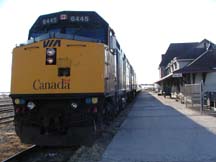 to Churchill for a 6-day/5-night stay. The
slow train through virtually unpopulated marshes, lakes and barren tundra is a leisurely
time shift back to days when passenger trains were commonplace. With comfortable seating,
panoramic windows, a dining car reminiscent of an Agatha Christi novel and sleeping
accommodations where we'll be lulled to sleep by the clickity-clack of the rails, this
will be a memorable experience.
to Churchill for a 6-day/5-night stay. The
slow train through virtually unpopulated marshes, lakes and barren tundra is a leisurely
time shift back to days when passenger trains were commonplace. With comfortable seating,
panoramic windows, a dining car reminiscent of an Agatha Christi novel and sleeping
accommodations where we'll be lulled to sleep by the clickity-clack of the rails, this
will be a memorable experience.
Soon after we check into our hotel, we'll start visiting the great birding sites of the
area. From the breathtaking vantage point of the cape where the river meets the bay we can
see jaegers, gulls, terns and ducks gather along the edges of the ice flows as they break
up. On this portion of our trip we could see close to a hundred species, a notable number
for this far north and a testament to its popularity among serious birders. Among other
nesting species present at this time are American Bittern  , Pacific and Red-throated loons, Common Eider,
Long-tailed Duck, all three scoters, Tundra Swan ,
Parasitic Jaeger, Hudsonian Godwit, Willow Ptarmigan, Short-eared Owl, Blackpoll Warbler,
American Tree Sparrow, Harris's Sparrow, Common and Hoary redpolls, and Pine Grosbeak . The chance for rarities is always good.
Depending on weather conditions, and we could see Iceland, Sabine's and Thayer's gulls,
Gyrfalcon, Yellow Rail, and Red Phalarope. We could see a Polar Bear, although peak time
to find them is in late fall, and we are more likely to see Beluga Whales, particularly if
the ice has cleared. Another delightful northern mammal is Arctic Hare
, Pacific and Red-throated loons, Common Eider,
Long-tailed Duck, all three scoters, Tundra Swan ,
Parasitic Jaeger, Hudsonian Godwit, Willow Ptarmigan, Short-eared Owl, Blackpoll Warbler,
American Tree Sparrow, Harris's Sparrow, Common and Hoary redpolls, and Pine Grosbeak . The chance for rarities is always good.
Depending on weather conditions, and we could see Iceland, Sabine's and Thayer's gulls,
Gyrfalcon, Yellow Rail, and Red Phalarope. We could see a Polar Bear, although peak time
to find them is in late fall, and we are more likely to see Beluga Whales, particularly if
the ice has cleared. Another delightful northern mammal is Arctic Hare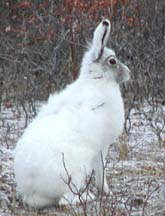 , a
rather large animal that is fascinating to watch as it hops on all fours and then stops to
pose on its hind haunches.
, a
rather large animal that is fascinating to watch as it hops on all fours and then stops to
pose on its hind haunches.
Churchill itself is an intriguing town to visit, a population in the middle of nowhere,
small enough that everybody knows everybody and their "Northern Exposure"
personalities peak curiosity. One of the local residents - and a birder - will give us a
tour of the area, answering our inquisitiveness about why this area was settled centuries
ago, its strategic military and commercial history, as well as the unusual natural history
of the area.
We return to Thompson by train - perhaps encountering Barren Ground Caribou, Black Bear
and Moose - and then push south by RV to Winnipeg in southeastern Manitoba, where we will
end our trip. Winnipeg, a melting pot of cultures with 900 restaurants and oodles of
ethnic specialties, will stand in stark contrast to the other towns we've visited: quaint
vacation spots like Wasagaming, working towns like The Pas, or the remote native villages
we'll see from the train just north of Thompson. Our last great birding stop will be an
extensive marsh, sporting a good density of nesting waterfowl and marshland and prairie
birds such as Sedge Wren , Clay-colored
Sparrow, Yellow-headed Blackbird and Bobolink. Our farewell dinner will be a final
celebration of the 200+ species we're likely to have on our ending tabulation.
.
SPECIAL: This is an exclusive caravan, limited to only ten customer rigs
(plus one or two extras to allow for later cancellations) and less than
half the size of most caravans. Based on customer surveys we are restricting the size of
our group. This gives the distinct advantage of easier caravan travel and parking, and
more flexibility on side trips and accommodations at great birding spots not available to
traditional caravan sizes. Greater attention from the birding guides, the social directors
and the staff significantly enhances the value of this specialized caravan trip.
This web site is designed by Bert Frenz.
Copyright © 2004-2009 Bert Frenz. All rights reserved.
Revised: May 06, 2009.